The 1930 Wheat penny value depends on several factors. Frankly speaking, the year is not a key rarity in the Lincoln Wheat series. Most pieces are easy to find. Yet the market does not treat all 1930 cents the same. A dull brown coin with soft detail trades in one range. A sharp red coin with clean fields trades in another. That gap is the real subject here.
This cent is an ordinary Lincoln Wheat issue for mass use. The coin was struck in Philadelphia, Denver, and San Francisco. The piece is a bronze coin with a plain edge, a 19 millimeter diameter, and a standard weight of 3.11 grams. No proof version was made for 1930, so the value discussion stays with business strikes only.
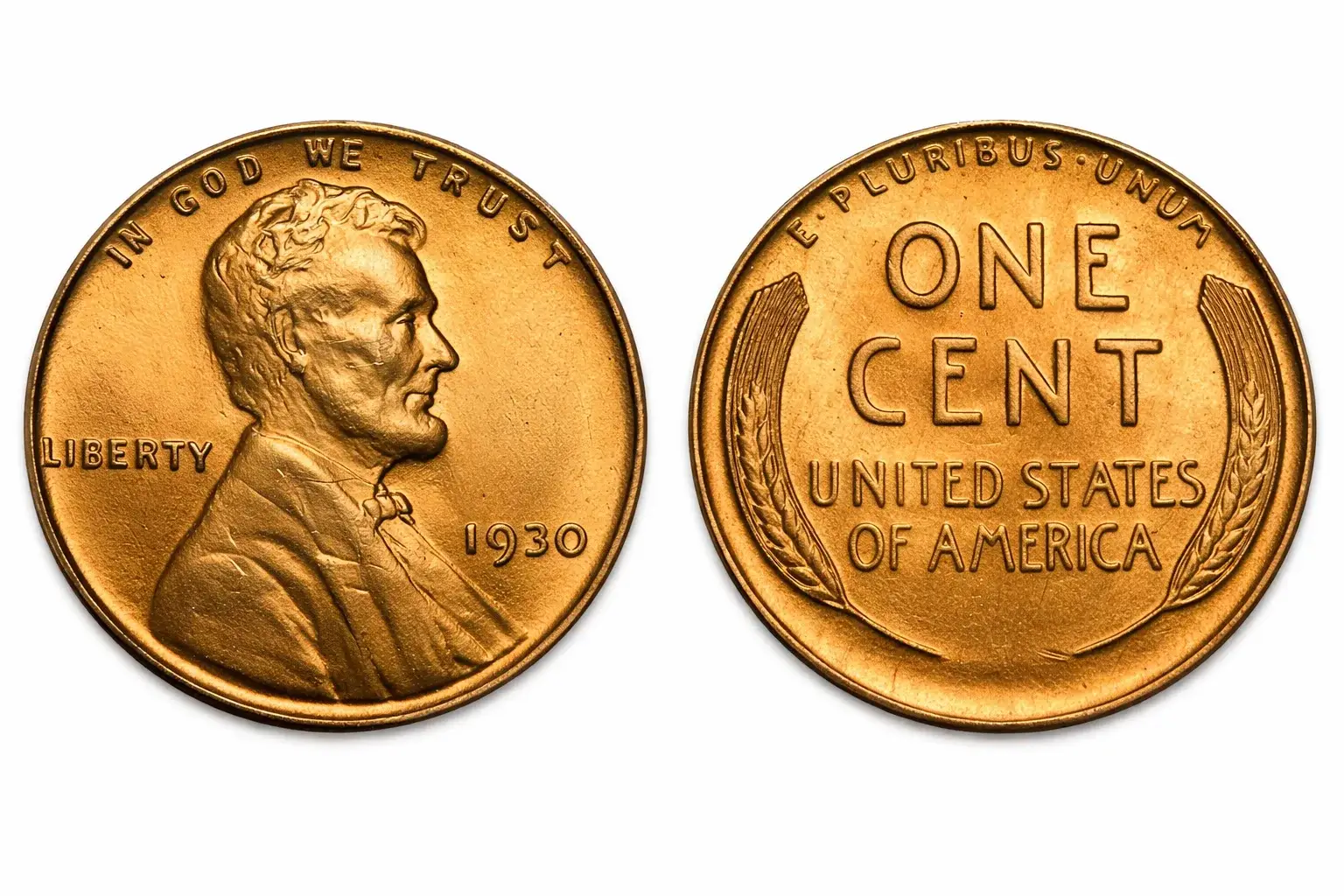
1930, 1930-D, and 1930-S: The Basic Market Setup
The three issues start from the same design, but not from the same market position. Philadelphia had the largest mintage. Denver and San Francisco had smaller outputs. That matters, but it does not decide everything.
A circulated 1930 Philadelphia cent is usually a low-cost album coin. A circulated 1930-D is still affordable. A circulated 1930-S also stays within reach for most collectors. The difference is visible only in case the color improves, the marks become fewer, and the coin moves into better Mint State territory. The 1930-D is harder to find in Gem condition, while the 1930-S starts to become more difficult from about MS64 and up.
Here is the broad market picture.
| Date | Mintage | General market range |
| 1930 | 157,415,000 | about $0.36 in average condition; about $7.29 to $12+ in Mint State |
| 1930-D | 40,100,000 | about $0.36 in average condition; about $15 to $38+ in Mint State |
| 1930-S | 24,286,000 | about $0.43 in average condition; about $12 to $15+ in Mint State |
These are broad retail-style estimates for ordinary examples. They do not describe top red coins, premium eye appeal, or auction-level condition rarities. They are useful because they show the first point clearly: the 1930 date is common enough that quality, not just mintage, drives the stronger premiums.
No Proof Shortcut
There are no proof issues for this date. Proof Lincoln cents resumed in 1936, not in 1930. That removes one common source of confusion. A flashy 1930 cent is not a proof. It is still a business strike. The question is whether it has better-than-average strike, better color, and more original surfaces.
Strike: Why Sharp Detail Matters
Strike is the first real separator.
Many new collectors start with wear. That is natural. Wear is easy to see. Strike takes more practice. A 1930 cent can show limited wear and still look weak. The portrait may seem soft. The wheat ears may look flat. The lettering may lack force. The rims may not feel crisp. That is a strike problem, not always a wear problem.
On this date, look first at the hair above Lincoln’s ear. Then check the jaw and beard area. Turn the coin over and study the wheat lines. The reverse does not need to look prooflike. It needs to look complete. Strong lettering helps. Strong rims help. A coin with full-looking design elements usually has better eye appeal. Buyers respond to that.
The market responds too. A strong strike does not guarantee a high grade. It does not erase spots or marks. Still, it lifts the coin. A 1930 cent with sharper detail usually feels fresher and more desirable than a flat, washed-out piece in the same general grade range.
Start with a coin scanner app free option to confirm the date and mint mark before they study the finer points. That can save time during sorting. It does not replace close viewing. Strike still has to be judged by the eye.
A simple strike check works well here:
- Hair detail above the ear
- Cheek and jaw separation
- Clean lettering
- Complete-looking wheat lines
- Rims with steady strength
This factor matters most when the coin approaches Mint State. In low circulated grades, strike matters less because wear already limits the look. In Mint State, strike can decide whether the coin feels average or premium.
Color: Brown, Red-Brown, and Red, and Different Price Bands
Color is one of the biggest price drivers for a bronze Wheat cent.
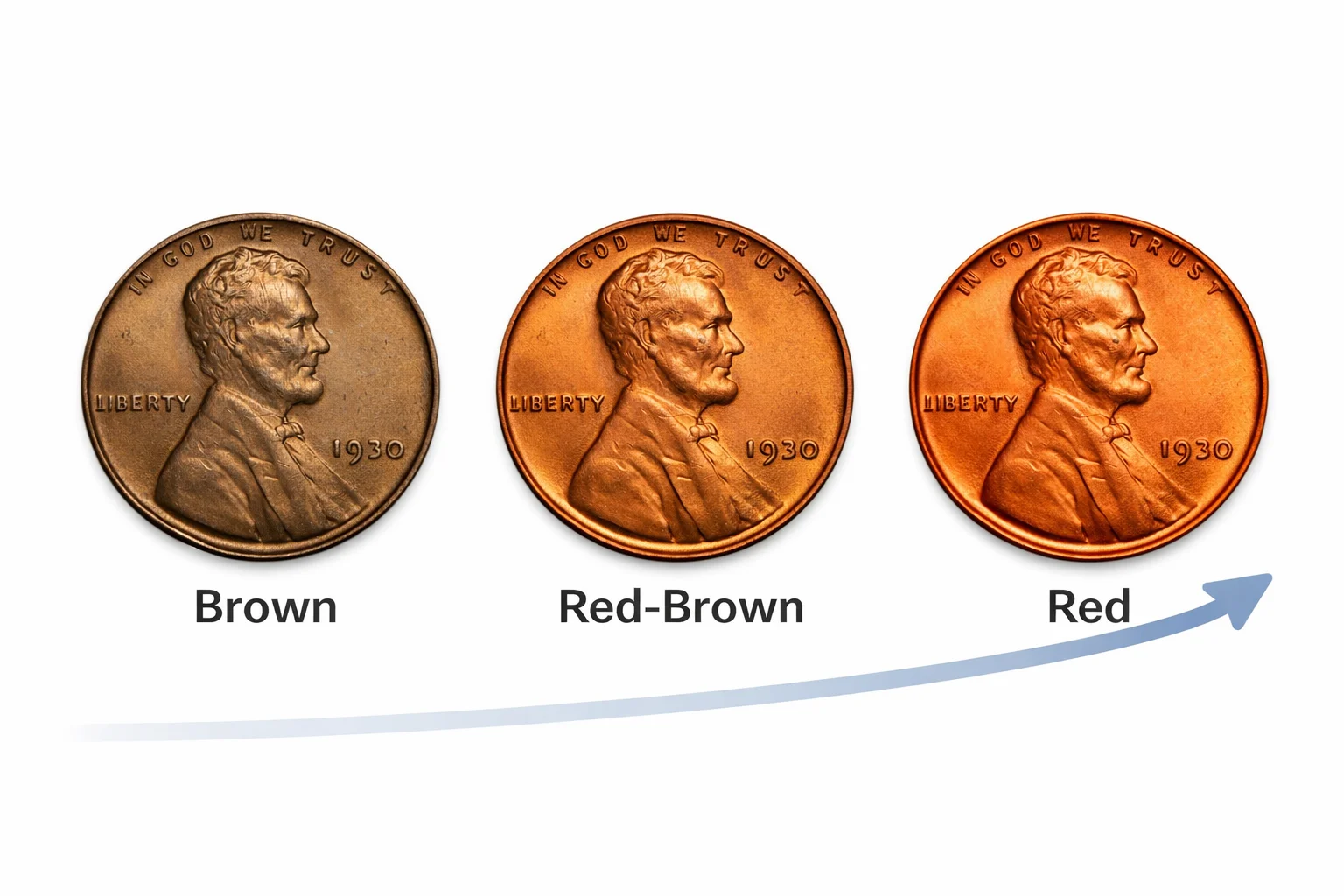
Collectors use three standard designations: Brown, Red-Brown, and Red. Brown coins lost most of their original mint red. Red-Brown coins keep some of it. Red coins keep much more. The labels sound simple. The price effect is not small.
For a 1930 cent, color often changes the market faster than the date does. That is why one coin can sit in a budget box while another, from the same year, reaches into strong three-figure or even four-figure territory.
This becomes clear when you compare typical Mint State ranges.
| Date | Brown market range | Red-Brown market range | Red market range |
| 1930 | about $4.40 to $33 | about $5.50 to $44 | about $19.80 to $121, with MS67 around $363 |
| 1930-D | about $13.20 to $31 | about $18.70 to $110 | about $39 to $539, with MS67 around $6,600 |
| 1930-S | about $8.80 to $22 | about $9.90 to $110 | about $31 to $440, with MS67 around $6,050 |
These published price guides show the pattern well. Brown coins stay modest. Red-Brown coins rise. Red coins enter a different tier, especially for the branch mints.
Color alone still is not enough. A bright coin with bad surfaces can disappoint. A toned Brown coin with honest skin can still be attractive. The market pays best for original-looking color, not just bright color.
That point matters. Some old copper has been cleaned, brightened, or otherwise altered. It may look flashy at first glance. Under stronger light, it often looks wrong. The surface appears hard, pale, uneven, or stripped. Real red is valuable. Artificial brightness is not the same thing.
Surface Quality: This Is Where Many 1930 Cents Lose Their Premium
Surface quality is where average coins fall apart.
A 1930 cent may have a decent strike and still miss the premium because the fields are too noisy. Marks on the cheek. Small carbon spots. Hairlines from old wiping. Fingerprints. Tiny rim hits. A dull patch near the date. These problems add up fast.
The coin does not need to be perfect. It does need to look right.
That is the practical rule. Original surfaces matter more than a dramatic first impression. A natural brown coin with smooth fields often beats a brighter coin with obvious abuse. A red coin with scattered spotting may still hold value, but it loses part of the premium that a cleaner piece would command.
These are the most common surface problems that hurt a 1930 cent:
- Obvious cleaning
- Unnatural brightness
- Hairlines in the open fields
- Carbon flecks and dark spots
- Hits on the cheek or rim
- Dull, lifeless surfaces
The cheek is a key area. It is open and easy to read. If the cheek is crowded with marks, the whole coin feels weaker. The fields tell the same story. Clean fields support eye appeal. Busy fields lower it. That is true even before the grade changes.
For branch-mint coins, this becomes even more important. The 1930-D and 1930-S are not major rarities in low grades, but once collectors start paying for red color and better preservation, surface quality becomes harder to ignore.
Grade Changes the Price, but Grade Does Not Explain Everything
Grade still matters. It always matters. The point is that grade does not work alone.
A 1930 cent in Good or Very Fine is mostly a low-cost collector coin. In Extra Fine and About Uncirculated, buyers become more selective. In lower Mint State, the market begins to separate decent coins from stronger ones. In Gem Red, that separation grows much wider.
The Red price structure shows it clearly.
| Grade | 1930 | 1930-D | 1930-S |
| MS63 RD | $20 | $39 | $31 |
| MS64 RD | $29 | $77 | $58 |
| MS65 RD | $44 | $149 | $99 |
| MS66 RD | $121 | $539 | $619 |
| MS67 RD | $363 | $6,600 | $6,050 |
The jump is not linear. It becomes steep when top color meets top preservation. That is why a 1930-D or 1930-S can look ordinary in one holder and suddenly look expensive in another. The branch mints get harder in the higher Red grades. PCGS and Greysheet-linked references both reflect that pattern.
This is also why the phrase “it is just a 1930 penny” does not work well once the coin reaches Gem territory. In the lower tiers, that sentence is fair. In the upper Red tiers, it misses the real market.
What to Check Before Paying More
A buyer does not need a microscope to improve decisions. A clean routine is enough.
Start with the overall look. Then move closer. Confirm the date and mint mark. Study the color. Check the cheek. Check the fields. Flip the coin and look at the wheat ears. That short sequence catches most of the important points.
A useful routine looks like this:
- Confirm the date and mint mark
- Judge whether the color looks original
- Inspect the cheek and open fields
- Compare the reverse sharpness
- Watch for cleaning or hairlines
- Look for spots or distracting marks
- Compare the asking price with the coin, not just with the label
A coin appraisal app free search can help as a quick reference when comparing several raw pieces. Coin ID Scanner is practical because it can pull the basic coin card, show the main specs, and help keep similar cents in one digital group while you sort them. That is useful when several 1930, 1930-D, and 1930-S pieces sit side by side. Strike, color, surface, and detailed answers of the Coin ID scanner app decide the best coin.
When a 1930 Wheat Penny Deserves a Premium
A premium 1930 cent usually combines several strengths.
It has stronger detail than average. Its color is better preserved. Its fields look cleaner. The marks do not dominate the cheek. The surfaces still look natural. None of these factors has to be perfect on its own. The point is balance.
That is how the better coins separate from the rest.
A premium 1930 cent usually shows:
- sharper strike
- stronger original color
- cleaner fields
- fewer distracting marks
- better balance for the grade
The reverse case matters too. A weakly struck coin with spots and old cleaning may still be collectible. It just will not command the same respect. That is the right way to think about this date. Premiums are selective. They are not automatic.
Answer for Collectors: Is the 1930 Penny Worth Your Collection?
Yes. It is worth collecting. The reason is not rarity alone.
This date works well in a Wheat cent set because it teaches real market logic. A collector can study the same year in three mints. A collector can compare Brown, Red-Brown, and Red. A collector can also see how strike and surfaces change the price more than many beginners expect.
Philadelphia is useful as a base coin. It is easier to buy well. The 1930-D is more interesting once Gem quality enters the discussion. The 1930-S becomes more serious from the better Mint State levels upward. That makes the date practical for both album builders and more advanced buyers.
It is not a famous key. It is not a throwaway coin either. It sits in the middle, and that makes it useful. The coin is common enough to study. The better examples are scarce enough to reward selection.
FAQs
Is a 1930 wheat penny rare?
Not in the usual sense. Most circulated examples are common. The difficulty appears in better Mint State coins, especially red branch-mint pieces.
Which is usually stronger in the market: 1930, 1930-D, or 1930-S?
In ordinary grades, the differences stay moderate. In higher Red grades, 1930-D and 1930-S usually show the stronger premiums. That is where the branch mints pull away.
Does red color really matter that much?
Yes. For this date, Red coins sit in a clearly higher price band than Brown coins. The gap becomes much larger once the coin reaches Mint State.
Can a cleaned 1930 cent still have value?
Yes. It still has collector value as a date coin. The problem is the premium value. Cleaning often lowers eye appeal and weakens resale strength.
Are errors the main reason a 1930 cent becomes expensive?
Usually no. This date gets most of its value from grade, color, strike, and surface quality. Errors and varieties are a separate layer. They are not the main market story for ordinary 1930 cents.
Is a 1930 wheat penny good for a beginner collection?
Yes. It is affordable in lower grades and useful for learning the difference between average copper and premium copper.
Were any proof 1930 wheat pennies made?
No. Proof Lincoln cents resumed in 1936. A 1930 cent should be judged as a business strike issue.
Conclusion
The 1930 Wheat cent is not valuable because the date is rare by itself. It becomes valuable when quality rises.
That quality comes from three places. Strike. Color. Surface quality.
A weak brown coin with noisy fields stays modest. A sharp red coin with clean surfaces moves into another market level. That is why two 1930 cents can carry very different prices even when the date is the same.
For collectors, that is what makes this coin worth studying. It teaches the right habit. Do not stop at the year. Look at the coin.
 admin
admin